
Mecklenburg Projected and Actual Release
A projected date estimates when a sentence may end after the responsible authority applies the judgment, jail credit, sentence-credit system, and current classification. It can move. The actual release date records an event that has already occurred. A jail or VADOC transaction, release letter, or notification can document that later event.
Pretrial custody works differently. A person awaiting trial has no sentence from which to compute a projected release date. A magistrate or judge may authorize bond, but MRRJ can release the person only after lawful conditions are met and other holds are resolved. A bond order proves authority under stated terms. It does not supply the time of departure and does not dismiss the charge.
Transfer is another key limit. Departure from MRRJ for VADOC, another jail, federal custody, or ICE ends one facility's control but does not place the person in the community. A detainer, meaning another authority's request to hold or receive the person, can also change the expected outcome.
Find Mecklenburg Projected Release Records
Begin with the last known custodian and sentence type. For a state prisoner, use the VADOC Inmate and Supervisee Locator. Search by seven-digit DOC ID when possible, or enter the first three letters of the first name and the full last name. Optional filters include location, race, gender, and age range. Accept the disclaimer, complete the verification step, and compare all available identifiers.
The research could not capture a live profile because of the site's verification control. Therefore, no label such as “Projected,” “Tentative,” or “Expected Release Date” should be assumed. Read the date label exactly as the current profile displays it. VADOC describes the field only as a release date in its public search explanation and warns that locator data updates daily yet may be inaccurate or stale.
- Identify whether MRRJ, VADOC, a federal agency, or another jail controls the sentence.
- For VADOC, search by DOC ID and transcribe the current profile label word for word.
- For a local sentence, compare the signed Mecklenburg court order with MRRJ Records data.
- Ask which agency performed the time computation and whether another term or hold applies.
- Record the retrieval date because any forward-looking result may change.
- After the event, obtain the release type, time, and destination from the releasing authority.
A VADOC no-result does not prove final discharge. The locator is built around current custody and supervision, so a fully discharged former prisoner may not remain visible. Spelling differences and system timing can also cause a miss. Court records, release papers held by the person, or an authorized records route may be needed.
Who Computes Mecklenburg Release Dates
Virginia divides computation work between local authorities and VADOC. A sentence of twelve months or less generally remains in a local or regional setting, though the actual order and other sentences control. MRRJ and the sentencing court are the proper starting points for that local term. The public court entry may show sentence length and disposition, but it may omit operational release time, some jail credit, or later adjustments.
VADOC computes state-responsible terms under the rules described on its Time Computation page. A state-responsible person can still be waiting at MRRJ for transport, so physical location alone does not settle which authority calculates the term. Ask the records unit rather than applying one formula to every Mecklenburg case.
The successful manifest capture from VADOC Time Computation shows the agency's own explanation of these separate systems.
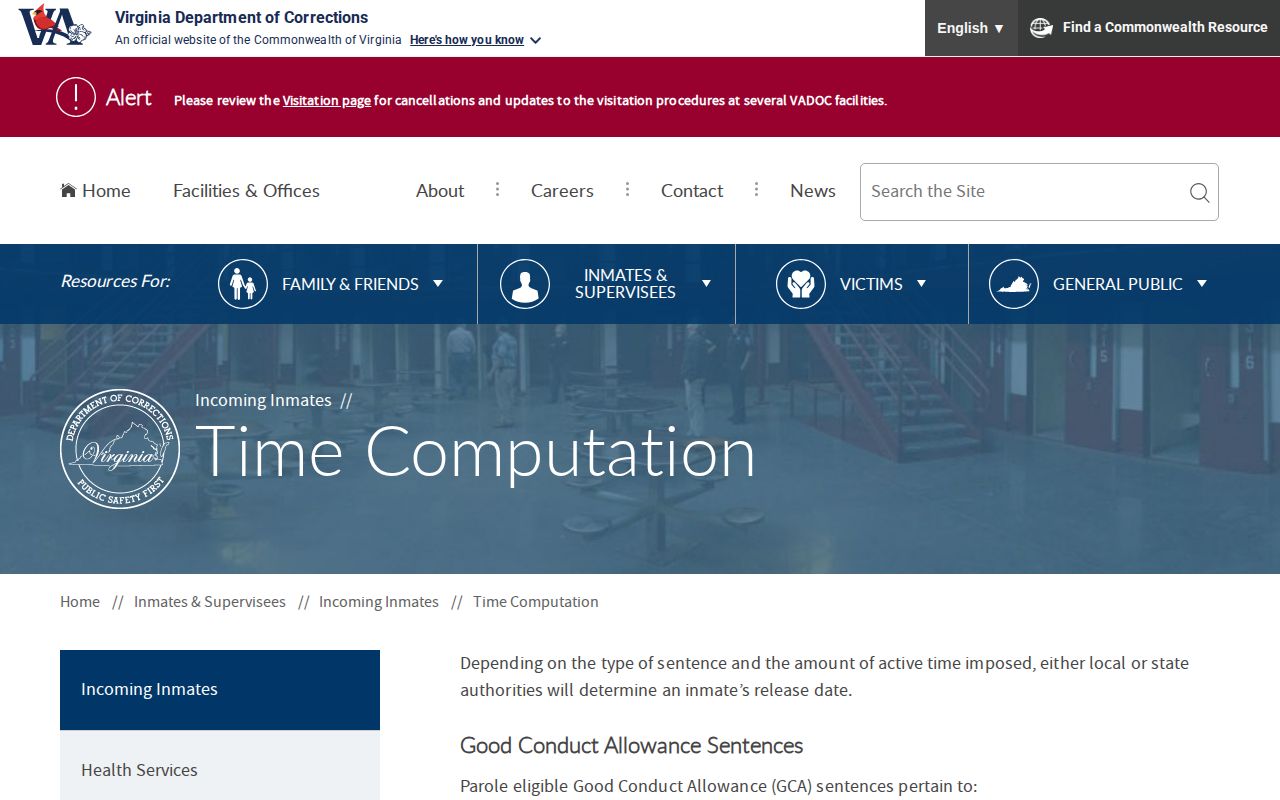
The state page is the right source for the framework. It is not a do-it-yourself calculator for a named person's release.
Mecklenburg Release Dates Under GCA
Good Conduct Allowance, or GCA, generally applies to felonies committed before January 1, 1995 and misdemeanors committed before July 1, 2008. For active or combined parole-eligible GCA terms over twelve months, VADOC calculates discretionary parole eligibility, mandatory parole release, and the good-time release date. Class-based earning can range from zero to thirty days per thirty days served.
Those broad dates and ranges do not replace the individual calculation. Offense dates, multiple sentences, time already served, and later corrections matter. Older Virginia Code provisions, including sections 53.1-199 and 53.1-202, must be read with VADOC's current explanation. An older GCA term should never be run through the newer ESC structure merely because both systems award sentence credit.
Mecklenburg Release Dates Under ESC
Earned Sentence Credits, or ESC, apply to felonies committed on or after January 1, 1995. VADOC calculates release when the active ESC sentence exceeds twelve months. Under current Virginia Code section 53.1-202.3, specified serious ESC-1 offenses can earn no more than 4.5 days for each thirty days served. Other eligible ESC-2 offenses use levels. Level I permits up to fifteen days per thirty, Level II permits 7.5, Level III permits 3.5, and Level IV permits zero.
One earned credit deducts one day under section 53.1-202.2. Eligibility is not fixed by the name of the credit system alone. The actual offense, effective-date provisions, current class, conduct, and statutory exclusions all matter. VADOC's classification and calculation are the records to follow.
Mecklenburg Release and the 85% Rule
VADOC explains that Virginia's abolition of discretionary parole for post-1994 felonies traditionally required at least 85 percent service with good-time credits. That phrase is a useful summary of the truth-in-sentencing model. It is not a universal calculator. The 4.5-days-per-thirty maximum corresponds to roughly 87 percent service over that interval, while eligible ESC-2 offenses may earn more and ineligible conduct may earn less or none.
The conviction and current statute decide which rate can apply. Applying a flat percentage to the sentence can miss jail credit, consecutive terms, offense-specific limits, amendments, and disciplinary class changes. For a Mecklenburg prisoner, use the shorthand only as background. Use the responsible agency's computation for the actual date.
Why Mecklenburg Release Dates Change
A forward-looking date changes when an input changes or the agency corrects its computation. Some changes concern sentence math. Others concern where the person goes when one term ends. Parole is also distinct: a Board Grant authorizes release through that process, but it does not prove that prerelease tasks were complete or that physical departure occurred.
| Factor | Possible effect | Best source |
|---|---|---|
| Jail credit | Credits qualifying time already held toward the active term | Signed order and computing authority |
| Concurrent or consecutive terms | Changes whether terms overlap or run one after another | Court orders and time-computation record |
| Earned-credit class | Raises, lowers, or stops the credit rate | VADOC computation |
| Discipline or reclassification | Can reduce credit and move the projected date later | Custodian's classification record |
| Amended court order | Changes the legal sentence input | Sentencing court and agency update |
| Detainer or hold | May send the person to another custodian instead of the community | Release transaction and receiving agency |
| Parole decision | May authorize release for an eligible term but requires later confirmation | Board report and VADOC release record |
A date correction is not always a penalty. It can result from a new certified order, added jail credit, or resolution of overlapping terms. Ask what changed and which record controls.
Program participation can affect classification or credits only when the governing rule says so. Never infer a new date from participation alone. The responsible agency must post or provide the revised computation, and the court order remains the source for any change to the legal sentence itself.
Mecklenburg Release Computation Is Split
Mecklenburg's distinctive issue is the two-level system. Local authorities handle some short terms, while VADOC handles state-responsible sentences. The older GCA and newer ESC frameworks then divide state calculations again. Current ESC rates can run from zero or 4.5 days per thirty for specified serious offenses to as much as fifteen per thirty for an eligible Level I case.
This split is why a homemade date calculator is unsafe. It may use the wrong authority, offense date, credit class, or sentence structure. It can also mistake the end of MRRJ custody for community release when the event is a VADOC transfer. A narrow agency answer is more useful than a precise-looking but unsupported date.
A short Mecklenburg sentence illustrates the risk. The online court result can show the imposed term but omit some operational inputs. MRRJ may need to apply jail credit, account for another commitment, and wait for a signed order. Jail VINE may report a later custody event, but it is not the computing office. Do not assume a release at midnight, on Friday, or on the next business day. No ordinary MRRJ release-time rule was found.
One published schedule is too narrow to generalize. MRRJ's weekender program has Friday reporting and Sunday release, yet that program does not establish timing for the jail population as a whole. Likewise, VADOC's state-facility timing belongs only to state institutions. The facility type and sentence authority must remain attached to every rule.
Confirm Mecklenburg Actual Release Dates
After the date arrives, look for an event record. VADOC says a person who completes a state sentence is discharged or leaves on parole and receives a notification-of-release letter. The person signs an Order of Release and, when applicable, Conditions of Probation or Conditions of Parole. If a detainer applies, departure can instead be a transfer to the next custodian.
VADOC's state-facility policy says release occurs by 11:59 p.m. on the release date, weather permitting, with paperwork, property, and account handling. That rule applies to VADOC facilities such as Baskerville Correctional Center. It must not be applied to MRRJ, which did not publish an ordinary release-time rule in the reviewed sources.
Virginia Code section 53.1-28 also allows the VADOC Director, for prerelease scheduling, to discharge a prisoner within thirty days before the term would normally expire and requires specified documents at discharge. This is another reason simple sentence arithmetic can diverge from the agency's date. It concerns state prisoners and does not govern an MRRJ bond release.
For MRRJ, ask Records for the existing release transaction, including date, time, type, and destination. Jail VINE can send a local custody event notice but is not the calculation authority. The Mecklenburg VINELink inmate search guide explains that notification path and the separate VADOC NAAVI system.