
Mecklenburg Parole and Probation Compared
Probation is a court-ordered form of community supervision. A judge may impose it instead of active confinement or after part of a sentence has been suspended. For that reason, a probation result does not prove that the person was released from a prison. Parole is conditional release from a prison term for a person who is legally eligible. Post-release supervision is another period of oversight that can follow incarceration under Virginia's modern sentencing system. VADOC administers community supervision, while the Virginia Parole Board makes parole decisions.
The distinction controls which record proves what happened. A sentencing order may establish probation. A Board decision may establish that parole was granted. Neither record alone supplies the moment of physical departure. A VADOC release letter, signed Order of Release, and an assignment to a district office provide stronger evidence of the transition from a state institution to community supervision.
| Record type | How it begins | What it can verify |
|---|---|---|
| Probation | A court imposes supervision, sometimes without a prison term | The court order and VADOC district assignment show the legal duty and active office |
| Parole | The Virginia Parole Board grants conditional release for an eligible prison term | The Board report shows its decision; VADOC records show the later custody change |
| Post-release supervision | A term follows incarceration under the sentence | Release papers and the locator can identify active VADOC supervision |
| Discharge | The supervision term lawfully ends | Final papers or the sentencing authority are stronger than a missing locator result |
Verify Mecklenburg Post-Release Supervision
The official starting point is the VADOC Inmate and Supervisee Locator. It covers people in Virginia institutions as well as probationers and parolees assigned to district offices. Search by the seven-digit DOC ID when it is known. Otherwise, enter the first three letters of the first name and the full last name. Location, race, gender, and age range are optional filters. Accept the disclaimer, complete verification, and open the result that matches the known identifiers.
Follow the displayed labels precisely. A district-office location can corroborate active community supervision after prison release, but it does not prove the exact release date. A person on probation might never have entered prison. VADOC says its locator updates daily and may still be inaccurate or stale, so save the search date and avoid reading more into a result than it states.
- Confirm the person's full name and DOC ID or date of birth when available.
- Search the VADOC locator and compare identifiers, supervision type, and listed location.
- If District 8 appears, treat it as proof of an active assignment, not a release timestamp.
- Check the sentencing court for the probation order or sentence terms.
- For parole, compare the monthly Board report with VADOC release papers and current status.
- Ask the proper agency about a conflict rather than choosing the more convenient result.
A no-result is also limited. It can be consistent with final discharge, but it can also reflect spelling, a delayed update, movement between systems, or a person outside the locator's current custody and supervision scope. The broader search and release-record path appears on the Mecklenburg County released inmates page.
Mecklenburg Supervision Through District 8
Mecklenburg County has no county-named VADOC probation and parole office. South Boston District 8 serves Mecklenburg, Halifax, and Lunenburg counties and the Town of South Boston. Its physical location outside Mecklenburg is easy to misread. Someone may return to Mecklenburg while the public locator displays South Boston as the supervision office.
VADOC South Boston District 8
2510 Houghton Avenue
South Boston, VA 24592
434-575-5774
Chief: Antwain Davis
Use the office for an appropriate operational question after checking the locator. Provide a full name and DOC ID or date of birth when known, and expect limits on what staff can disclose. District staff supervise cases; they do not maintain a public archive of everyone released from Mecklenburg facilities.
The official VADOC directory capture shows the state source used to locate District 8 and Mecklenburg's facilities.
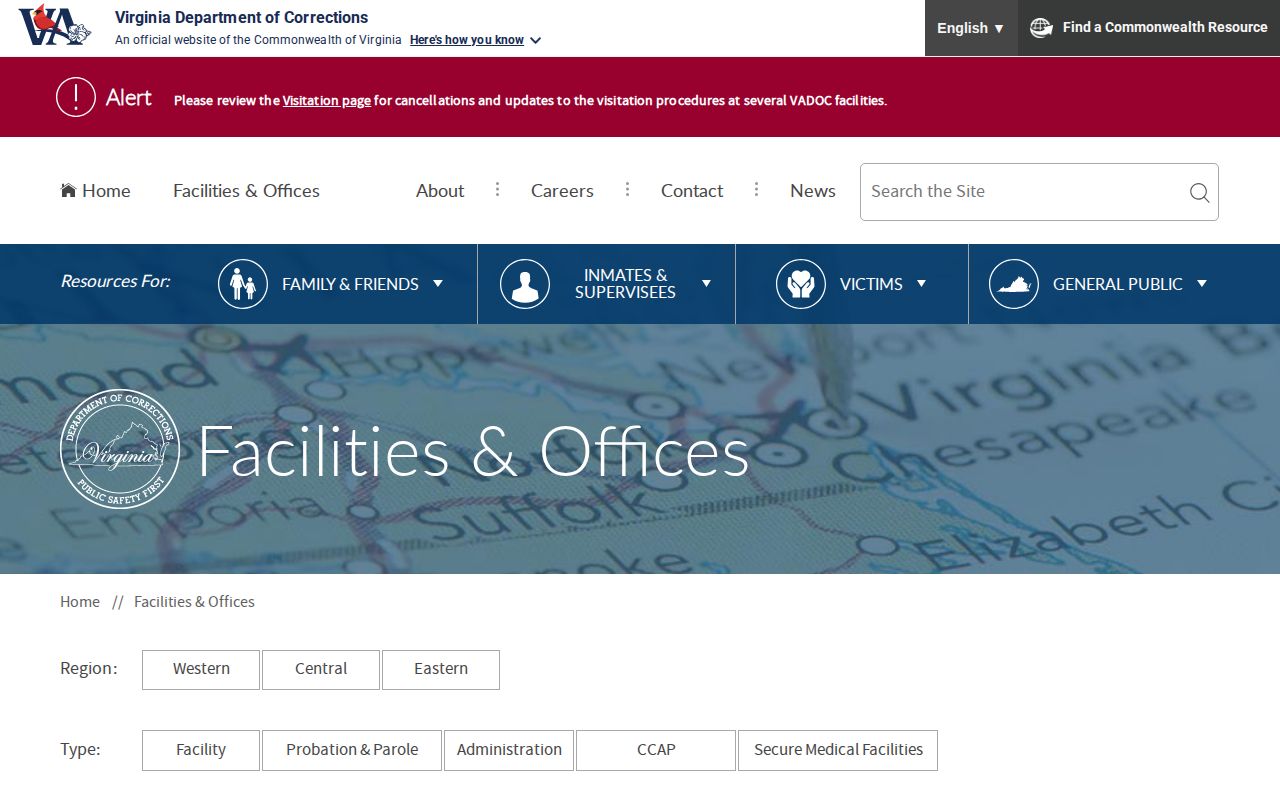
The directory entry should be read as an office assignment. It is not a release list and does not supply the precise time a person left custody.
Mecklenburg Parole Board Decision Records
The Virginia Parole Board publishes monthly decision PDFs through its Parole Reports page. These reports can include the DOC number, name, case type, decision and certification dates, reasons, jurisdiction, offenses, estimated time served, sentence facts, and individual votes. The observed result labels are “Grant” and “Not Grant.” Match the DOC number and Mecklenburg jurisdiction before relying on a name.
A Grant means the Board voted to authorize parole through its process. It does not mean the person walked out that day. Prerelease checks, signed conditions, a detainer, or another event can intervene. A detainer is an official request by another authority to hold or receive a person. Physical release requires confirmation from VADOC and, where applicable, the new District 8 assignment.
Eligibility depends on the offense date and statute. Virginia Code section 53.1-165.1 generally bars discretionary parole for felonies committed on or after January 1, 1995, subject to current exceptions. Older eligible sentences follow categories in section 53.1-151. Geriatric conditional release has a separate route under section 53.1-40.01, apart from the ordinary Board process. These rules help explain why two people with similar sentence lengths may have different parole records. They do not decide any named case without the conviction and sentence details.
Public meetings follow a separate path. Since July 2024, final deliberation and a grant vote require a public meeting in which victims may participate. The Board's meeting page lists upcoming dates, agenda or live links, and past minutes, but warns that not every eligible person has a public meeting. The rolling calendar is not a fixed person-search schedule.
The captured Parole Board public meeting page illustrates where the Board posts that changing calendar.

Use the calendar for process and timing. Use monthly reports for the decision, then use VADOC for the actual custody transition.
Mecklenburg Supervision and Absconder Status
Conditions of supervision are the rules a person must follow while a probation, parole, or post-release term remains active. The signed conditions control the individual case. They may require reporting, approved residence, court compliance, and other case-specific conduct. A public summary should not guess at terms that are absent from the order or signed form.
An absconder is not a person who completed supervision. VADOC uses that status after reasonable efforts fail and the person's whereabouts remain unknown. The inquiry may include the approved residence, local jails, and hospitals. Depending on the case, court or Parole Board warrant processes may follow. No comprehensive official Mecklenburg-specific public absconder list was found, so an old web claim or mere inability to locate someone is not enough to assign that status.
Virginia Jail VINE does not track community supervision. It reports local or regional jail custody events. VADOC's NAAVI service sends eligible victim notices for state-prison events, but it does not serve as a public probation or parole roster. Use the VADOC locator and District 8 for current supervision questions.
Mecklenburg Release Reentry Council Access
VADOC lists a South Boston Re-Entry Council that meets quarterly in hybrid form on the last Tuesday at 10 a.m. The council is part of the local transition landscape for people returning to Mecklenburg and the other District 8 communities. It can point toward reentry coordination, but it is not an inmate archive, a supervision search, or proof of release.
This distinction matters when a family sees “South Boston” on a locator result. The district assignment is the record-based clue. The reentry council is a separate navigation resource. Neither should be substituted for the person's Order of Release, supervision conditions, or final discharge paperwork.
Why Mecklenburg Supervision Shows South Boston
A released state prisoner can live in Mecklenburg County and still report to an office in South Boston. District boundaries, not county naming conventions, govern the assignment. Thus, a South Boston District 8 result may corroborate active Mecklenburg-area supervision even though its street address is in Halifax County.
That office label answers “who supervises the person now?” It does not answer “when did the prison release occur?” Keep both questions apart. A VADOC notification-of-release letter and signed Order of Release document the custody transition, while the locator and district office establish the current supervision setting.
Mecklenburg Supervision Discharge Records
Supervision ends through a lawful discharge, not merely because a public search stops returning a match. Keep the final court or VADOC paperwork when available. For a person once held at Baskerville Correctional Center, release papers can distinguish parole or post-release supervision from final discharge. For someone whose probation began in court, the sentencing and later discharge orders are the core records.
Virginia law permits VADOC to withhold broad imprisonment and supervision files under listed public-records exemptions. The public locator, the person's own release and discharge documents, and the sentencing court are often more useful than a broad request for an entire offender file. State the narrow fact each source supports. That approach prevents a Board Grant, an office assignment, or a missing search result from being mistaken for the full release history.